
GLOSSARY · AGILE LEADERSHIP
What is agile leadership?
And how does agile leadership differ from classic, hierarchical leadership?
Modern leadership in agile organizations
VUCA: volatility, uncertainty, complexity and ambiguity. The acronym describes the conditions companies operate in today.
Agility: the ability of a system to change actively and lastingly so it can hold up under new conditions. Agile leadership is leadership in exactly such systems.
What is agile leadership?
Our world is shaped by constant change, disruption and uncertainty. To succeed in this VUCA world, companies have to adapt.
That agility is not only about structures and processes. Leaders have to be agile too, so they can develop their company into an agile organization together with their teams. Agile leadership is the ability of a leadership role to lead well under new and changing conditions.
But what happens when a company or project has no artificial hierarchy that shows who carries leadership responsibility?
Definition of agile leadership
Agile leadership is a leadership philosophy marked by flexibility, adaptability and a strong focus on the needs of the team. Agile leaders foster a culture of open communication, continuous learning and constant improvement. Instead of strict control and micromanagement, they rely on self-organization and the ownership of their teams. Their role is less that of a commander and more that of a coach who develops and uses individual strengths.
What makes up the agile leadership side of a modern manager?
Four core traits of agile leadership: It fosters self-organization instead of command and control. It empowers people instead of controlling them. It adjusts plans continuously instead of clinging to rigid five-year plans. And it creates orientation and security despite uncertainty instead of issuing fixed rules.
Leadership reimagined
Agile leadership is above all a new understanding of leadership: an agile mindset that calls for a different leadership stance. Instead of hierarchical command and control, a manager with purely technical authority becomes a real leader who is responsible for the right conditions.
One of the main tasks of a leader in an agile context is to enable people to do their work as effectively as possible, ideally with room for creativity and innovation.
That also means a modern leader has to engage more and more with the personalities around them, so they can support people individually and help them grow. Only then can they create a motivating and supportive environment.
Classic approaches like linear career models and bonus systems help as little with a focus on people as rigid five-year plans do in product development.
At the same time, leaders need to give people a frame despite the uncertainty, one that sets a direction and offers security and freedom in equal measure.
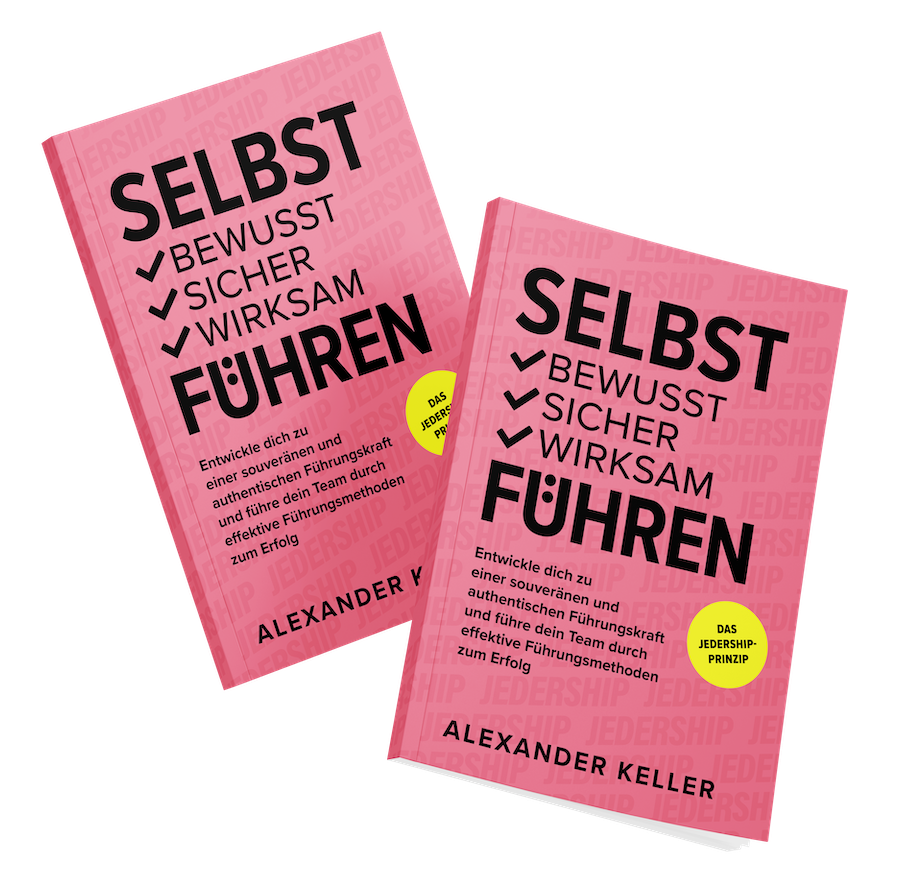
The book on agile leadership by Alexander Keller
"JEDERSHIP – SELBST bewusst | sicher | wirksam FÜHREN"
The book (in German) sorts classic, agile and lateral leadership and shows, with the JEDERSHIP principle in three steps, how you lead effectively even in uncertain, changing conditions: INSIDE-OUT-IN.
Want to develop your agile leadership?
GLOSSARY · QUESTIONS
Questions about agile leadership
Agile leadership is a leadership philosophy for uncertain, fast-changing conditions (VUCA). It relies on flexibility, self-organization and coaching instead of rigid control.
Classic, hierarchical leadership relies on fixed structures, control and instructions. Agile leadership relies on self-organization, empowerment and continuous adjustment instead of rigid plans.
VUCA stands for volatility, uncertainty, complexity and ambiguity, the conditions companies operate in today. Agile leadership is the ability to lead effectively in exactly these conditions.
They enable their team to self-organize, create orientation instead of rigid instructions, encourage open communication and adjust plans continuously to changing conditions, rather than practicing control and micromanagement.
Agile leadership can be trained, for example in the Agile Basics training or in leadership coaching, which works specifically on your agile leadership role.